


Happy New Year to all my valued readers! I am deeply grateful for your unwavering support and continued interest in my stock analysis. Your engagement and feedback have been incredibly motivating, and I'm thrilled to know that my content has been valuable to you.
As we move into a new year, I'm looking forward to continuing to provide you with insightful and in-depth stock analysis. My goal is always to provide you with meaningful perspectives that can help inform your investment decisions. To make sure you don't miss any updates, I invite you to subscribe. By subscribing, you'll have immediate access to my latest analysis and stock watch lists, delivered directly to your inbox.
I appreciate your trust in my work, and I'm looking forward to another year of exploring the dynamic world of stocks together. Whether you're a seasoned investor or just starting out, I hope to continue to be a part of your financial journey, providing valuable insights and information to help you navigate the markets with confidence.
Here's to a prosperous and successful year ahead! May your investment portfolio thrive, and may we all enjoy a year of growth, both personally and financially. Thank you again for being a part of this journey, and don't forget to sign up for all the latest updates and insights.
Short summary
French Luxury Conglomerate: Kering, a prominent name in the global luxury sector, hails from France, known for its rich heritage in luxury and fashion.
Flagship Brands: The group's portfolio is headlined by major brands like Gucci and Saint Laurent, each a powerhouse in the luxury fashion industry.
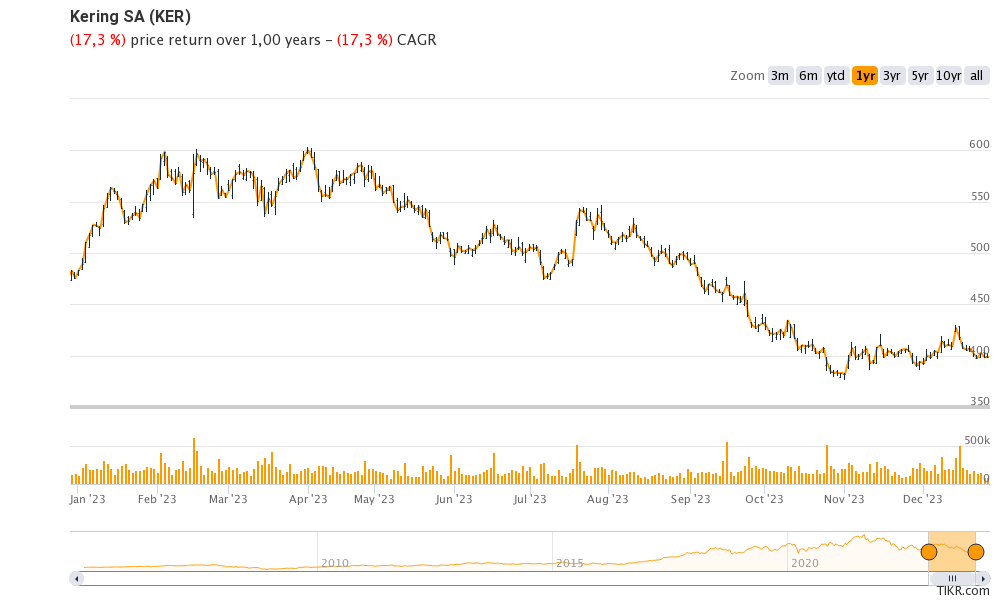
2023 Stock Performance: The year 2023 witnessed a downturn in Kering's stock performance, reflecting various market and operational challenges.
Strategic Transformation: In recent years, Kering has undergone a significant transformation, pivoting towards a model focused exclusively on luxury offerings.
Distribution Strategy Shift: A strategic shift has been made from wholesale to direct-to-consumer channels, emphasizing own retail stores and digital sales platforms.
Q3 2023: A Challenging Period: The third quarter of 2023 brought about negative sales growth, a testament to the challenges faced, though projections indicate a return to growth from 2024.
Strength of the Luxury Market: Despite recent hurdles, the luxury market, in general, remains strong and resilient, offering a positive outlook for companies like Kering.
Stock Valuation: Current analyses suggest that Kering's stock is undervalued, presenting potential opportunities for investors in the context of its future growth prospects.
Introduction
In my portfolio, Kering stands out as a stock that experienced a noticeable decline in value throughout 2023, a development that was admittedly rather discouraging. However, it's important to delve deeper into the context and potential of this stock beyond its superficial performance. In this analysis, I aim to shed light on Kering's strategic pivot toward becoming a preeminent pure-play luxury company. A key aspect of this transformation has been a strategic overhaul of its distribution channels, with a particular focus on minimizing wholesale exposure. While this approach has contributed to somewhat lackluster, even negative, growth in the third quarter, it promises significant long-term benefits.
It is impossible to overlook Kering's portfolio, which includes some of the world's most prestigious and iconic luxury brands. These brands not only bring inherent value and prestige, but also offer significant opportunities for growth and market expansion. This analysis will also look at the current valuation of Kering's stock. We'll examine whether the stock is undervalued, taking into account its future growth potential, historical financial performance, and a comparative analysis with its luxury peers. Through this comprehensive evaluation, we aim to understand Kering's true value in the marketplace and its prospects as a viable investment option.
About Kering
Kering is a major player in the global luxury market, with a rich history and significant presence in the luxury, sport, and lifestyle brand sectors. The company was established in 1963 by François Pinault and has undergone significant evolution over the years. A pivotal moment in its history was the acquisition of Gucci in 1999, which marked a major shift towards luxury. The company employs 47,227 people and is committed to sustainability and innovation while preserving the distinct identities of its brands. Kering, publicly traded on the Euronext Paris stock exchange under the ticker symbol 'KER,' is headquartered in Paris, France. Kering's blend of heritage, innovation, and focus on luxury has cemented its status as a key player in the luxury industry.
Kerings Business Model and Strategy
Kering's business model and strategic approach position it as a leader in the luxury market. The company blends creativity, sustainability, and a focus on long-term financial performance. Kering's vision combines the rich heritage of its brands with a bold, innovative outlook that caters to the evolving demands of the dynamic luxury market.
The company operates under a multi-brand model, with a diverse portfolio that includes well-known brands such as Gucci, Saint Laurent, and Alexander McQueen. This approach ensures that each brand maintains its creative autonomy while benefiting from Kering's long-term strategic guidance. Kering's operational ethos is based on the principles of agility, balance, and responsibility. These principles support the company's brands to flourish in their unique identities while being part of a cohesive and responsible economic model.
Kering's growth strategies focus on organic growth and value creation, which involves increasing market share in the luxury industry while maintaining a steadfast commitment to creativity and excellence in customer experience. Kering leverages its group strength to enhance synergies and develop growth platforms across its brands. This is exemplified in initiatives such as their specialized eyewear division.
Kering's competitive edge is further sharpened by its entrepreneurial culture, which encourages innovation and risk-taking, and the collective strength it derives from its ensemble of brands. Kering's core business practices reflect a significant focus on creativity and sustainability, as evidenced by their integration of environmental and social responsibility. This aligns with the growing consumer demand for ethical and sustainable luxury goods.
The luxury industry landscape in which Kering operates is characterized by several key trends. Today's consumers expect not only quality and creativity but also personalized and impactful experiences. Kering aims to meet customer demands by utilizing digitalization and an omnichannel approach to enhance customer experience across various platforms. Additionally, the company is expanding its presence in emerging markets and capitalizing on the growth of tourism while navigating the shift towards sustainable luxury.
Kering's organizational strategy emphasizes agility, enabling its brands to excel and adapt quickly to market changes. Kering achieves balance through a diverse portfolio of brands, each occupying a unique market position. The company embeds responsibility towards sustainable practices in every aspect of its operations.
Despite the challenges posed by evolving consumer expectations and the need for constant technological innovation, Kering's strategy is robust. It is geared towards harnessing the full growth potential of the luxury market, focusing on creativity, innovation, and sustainability. In doing so, Kering aspires to be a leader in economic performance and a trendsetter in the luxury world, respecting heritage while embracing modern demands, particularly in sustainability and digital engagement.
Kerings Transformation to Pure Luxury
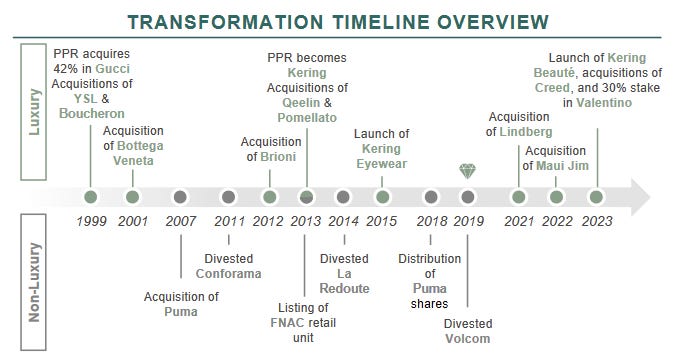
Kering has undergone a significant transformation in recent years, evolving from a diverse conglomerate into a leading player in the luxury industry. This transformation was achieved through strategic divestitures and acquisitions, which not only reshaped Kering's portfolio but also solidified its position as a prominent player in the global luxury market.
Embracing a Luxury-First Philosophy
Kering's pivot towards the luxury sector began with the acquisition of Gucci in 1999, which marked the genesis of its luxury-centric business model. This was further strengthened by acquiring other prestigious brands such as YSL, Boucheron, and Bottega Veneta. The rebranding from PPR to Kering in 2013 symbolized this strategic shift, solidifying its identity as a luxury-focused entity.
Expanding the Luxury Repertoire
Kering has experienced significant growth by investing in its luxury houses and expanding into new, high-value luxury segments. Kering's acquisition of the esteemed fragrance brand Creed and the creation of Kering Eyewear are examples of its diversification into different luxury categories, which has broadened its market reach and enhanced its brand portfolio.
Strategic Divestitures: Sculpting a Pure Luxury Profile
Kering transitioned to a luxury-centric organization through a series of strategic divestitures. Originally known as Pinault-Printemps-Redoute (PPR), the company's portfolio included retail, consumer goods, and luxury. To sharpen its focus on the luxury sector, Kering divested from non-core segments, such as retail ventures like Conforama and La Redoute. These divestitures represent a significant shift away from mixed-sector operations and towards a more sophisticated, luxury-focused business model.
Refining the Luxury Identity
In order to further its commitment to luxury, Kering divested itself of non-luxury assets, including selling its shares in Puma and the lifestyle brand Volcom. These steps were crucial in refining Kering's portfolio to a pure luxury essence, enabling a more focused and strategic deployment of resources in the high-end market.
Strategic Focus and Portfolio Optimization
Kering's divestitures were essential to its strategy of portfolio optimization, allowing it to concentrate its managerial and financial resources on luxury brands. This strategic refocusing has enabled Kering to devote greater attention and resources to nurturing its luxury brands, ensuring their competitive edge and prominence in the luxury market.
Financial and Market Implications
These strategic realignments have had a significant impact on Kering's financial health and market positioning. Kering streamlined its operations by divesting non-essential businesses, which could potentially enhance its financial performance and operational efficiency. Additionally, this sharpened focus has elevated Kering's stature in the luxury sector, aligning its brand perception more closely with the expectations of discerning luxury clientele and investors.
Kerings Brands (Houses)
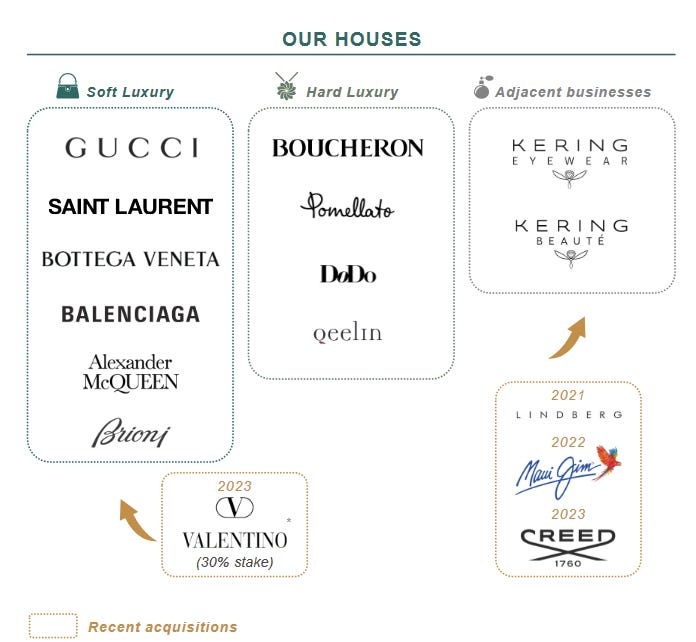
Kering's portfolio includes multiple luxury brands, referred to as 'Houses', each with its own distinct identity and heritage in the luxury market. Below is an overview of the main brands under Kering's umbrella:
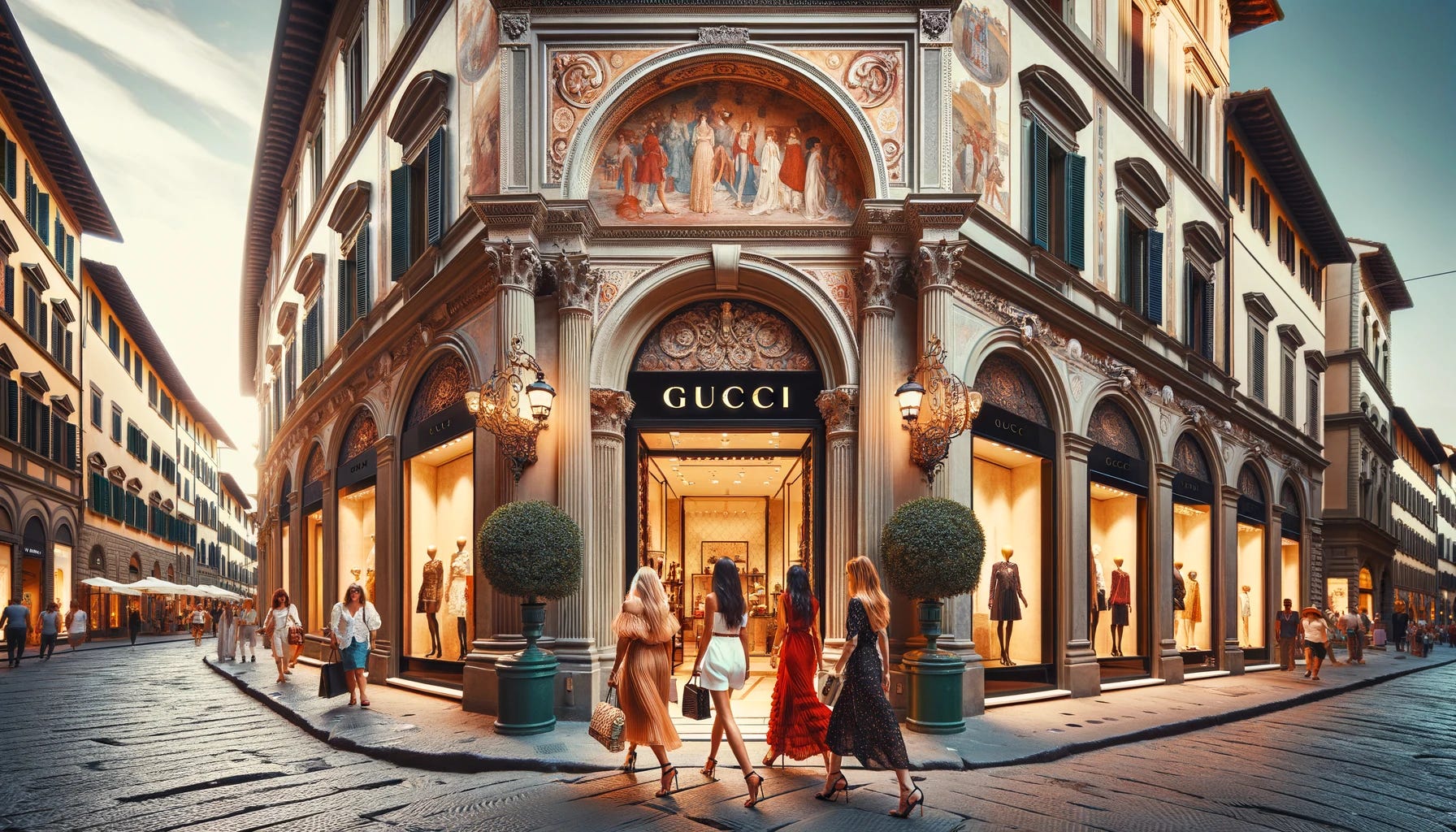
Gucci: Arguably the crown jewel of Kering's luxury empire, Gucci is renowned for its fashion and leather goods. With its iconic double G logo, Gucci has been a symbol of luxury and Italian craftsmanship since its founding in Florence in 1921.
Yves Saint Laurent (YSL): Acquired by Kering in 1999, YSL is a prestigious French luxury fashion house. Founded in 1961, it has been instrumental in revolutionizing modern fashion with its modern and iconic pieces, including tuxedos for women.
Bottega Veneta: Known for its discreet, no-logo design, Bottega Veneta is an Italian luxury goods and high fashion brand famous for its artisanal leather goods and handcrafted bags, shoes, and accessories.
Balenciaga: Founded in 1917 by Spanish designer Cristóbal Balenciaga, this brand is known for its avant-garde, innovative designs and has become increasingly influential in contemporary fashion under Kering's ownership.
Alexander McQueen: A British luxury fashion house founded by designer Alexander McQueen in 1992, it's known for its daring, emotional, and intricate designs.
Brioni: An Italian menswear couture house known for its made-to-measure men's suits, sartorial ready-to-wear collections, and leather goods.
Boucheron: One of the oldest jewelry houses in the Place Vendôme in Paris, Boucheron is famous for its exquisite jewelry, watches, and fragrance.
Pomellato: This Italian jewelry company specializes in colorful, stylish pieces that blend traditional craftsmanship with cutting-edge design.
Qeelin: A Chinese fine jewelry brand, Qeelin blends Chinese symbolism with contemporary styling.
Ulysse Nardin: A Swiss luxury watch brand known for its precision and craftsmanship, particularly in marine chronometers.
Girard-Perregaux: Another high-end Swiss watch manufacture with a long history dating back to 1791.
Kering Eyewear: A division of Kering handling the creation, development, and distribution of eyewear for many of the above Houses.
Creed: Creed is a high-end luxury heritage fragrance house. Established in 1760 by James Henry Creed, it is known for its long history and unique, handcrafted perfumes. Over the years, Creed has been celebrated for its quality and exclusivity, making it a prestigious name in the world of fine fragrances.
Valentino: Valentino is a famous Italian fashion house founded in 1960 by designer Valentino Garavani. The brand is recognized globally for its luxury clothing, accessories, and fragrances. Valentino is synonymous with elegance, craftsmanship, and attention to detail, making it a staple in high fashion circles.
These brands represent Kering's strategic focus on the high-end luxury market. They contribute to the conglomerate's reputation for luxury, quality, and exclusivity. Kering's diverse portfolio covers a wide range of luxury segments, including fashion, leather goods, jewelry, and watches, catering to a diverse luxury consumer base.
Kerings Key Financials
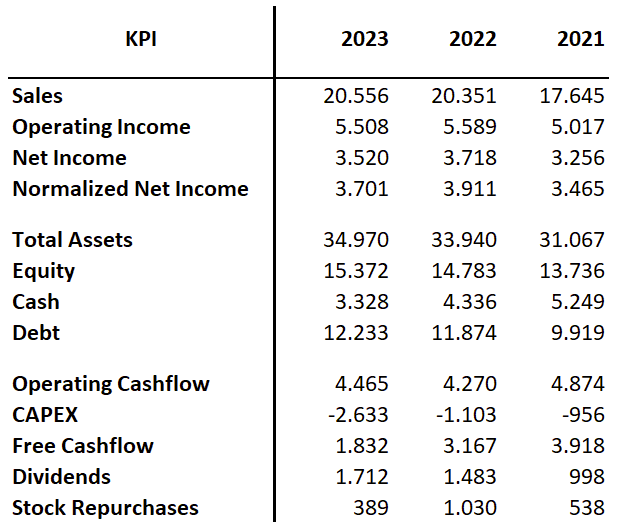
Kering's financial performance, as shown in its income statement, balance sheet, and cash flow statement, highlights the company's status as a high-quality business with exceptional financial metrics. An in-depth analysis of these figures reveals a strong financial structure and efficient operations.
Income Statement Highlights
Sales Revenue: Kering generated in the last twelve month €20.6 billion in sales revenue, indicating strong market demand and brand popularity.
Operating Income: The company's operating income was €5.5 billion, which reflects efficient operational management and profitability.
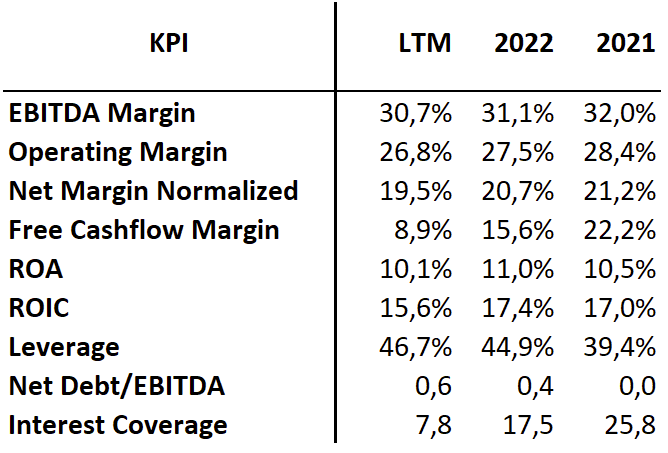
Operating Margins: Kering's ability to convert a significant portion of its sales into profits is demonstrated by the operating margin of nearly 27% in the Last Twelve Months (LTM).
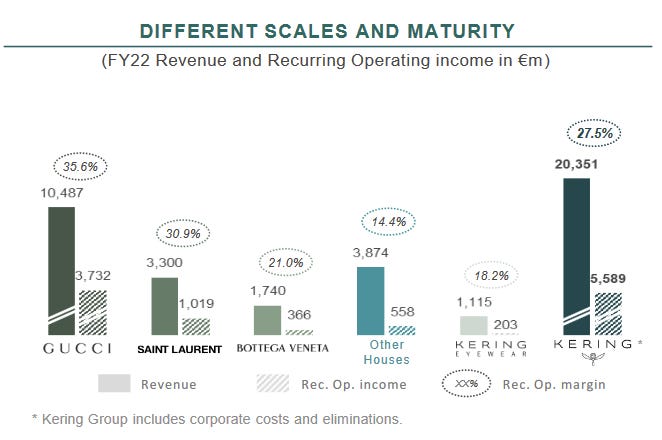
Brand-Specific Margins: Notably, Kering's flagship brands Gucci and Saint Laurent achieved exceptionally high margins of approximately 35.6% and 30.9%, respectively. These brands contribute roughly two-thirds of Kering's revenues and 85% of its operating income, highlighting their critical role in Kering's financial success.
Balance Sheet Insights
Equity Ratio: Kering's equity ratio stood at nearly 44%, indicating a strong balance sheet with a healthy proportion of equity financing relative to debt. This ratio demonstrates Kering's financial stability and lower financial risk.
Cash Flow Statement Analysis
Free Cash Flow Margin: Kering's free cash flow margin was under pressure, recording 8.9%, due to increased capital expenditures (CAPEX). This figure contrasts with the higher margins of 15.6% in 2022 and 22.2% in 2021. The increased CAPEX suggests significant reinvestment in the business for future growth.
Return on Invested Capital (ROIC): The ROIC of 15.6% is indicative of Kering's effectiveness in using capital to generate profits, a key measure of financial performance.
Overall Assessment
Kering's financials depict a company with a strong foundation, demonstrating high profitability and efficient capital utilization. The exceptional performance of its flagship brands, Gucci and Saint Laurent, significantly contribute to the company's overall success. Although the margins in other segments may not match those of Gucci and Saint Laurent, the diverse portfolio enhances Kering's resilience and market presence.
In conclusion, Kering's financial figures and key performance indicators (KPIs) reflect its status as a high-quality business. The company has strong margins, substantial sales revenue, a healthy equity ratio, and impressive brand-specific performances, which underscore its financial strength and market leadership in the luxury sector.
Kerings recent development
Kering's financial performance in 2023 demonstrated a blend of growth and challenges across its various segments, both in the first half and the third quarter of the year.
First Half of 2023
Group Revenue: Kering's group revenue reached €10.135 billion, marking a 2% increase both as reported and on a comparable basis.
Recurring Operating Income: The income amounted to €2.739 billion, with a recurring operating margin of 27.0%.
Net Income: Net income attributable to the group was €1.785 billion.
Free Cash Flow: The free cash flow from operations, excluding real estate acquisition and disposal, remained high at €2.1 billion, up 4%.
Segment Performance
Gucci: Reported €5.1 billion in revenue, down 1% as reported but up 1% on a comparable basis.
Yves Saint Laurent: Enjoyed a revenue increase to €1.6 billion, up 6% as reported and 7% on a comparable basis.
Bottega Veneta: Recorded €833 million in revenue, unchanged as reported but up 2% on a comparable basis.
Other Houses: Sales totaled €1.9 billion, down 5% as reported and on a comparable basis.
Kering Eyewear: Achieved a record revenue of €869 million, a 51% increase as reported and 16% on a comparable basis.
Third Quarter of 2023
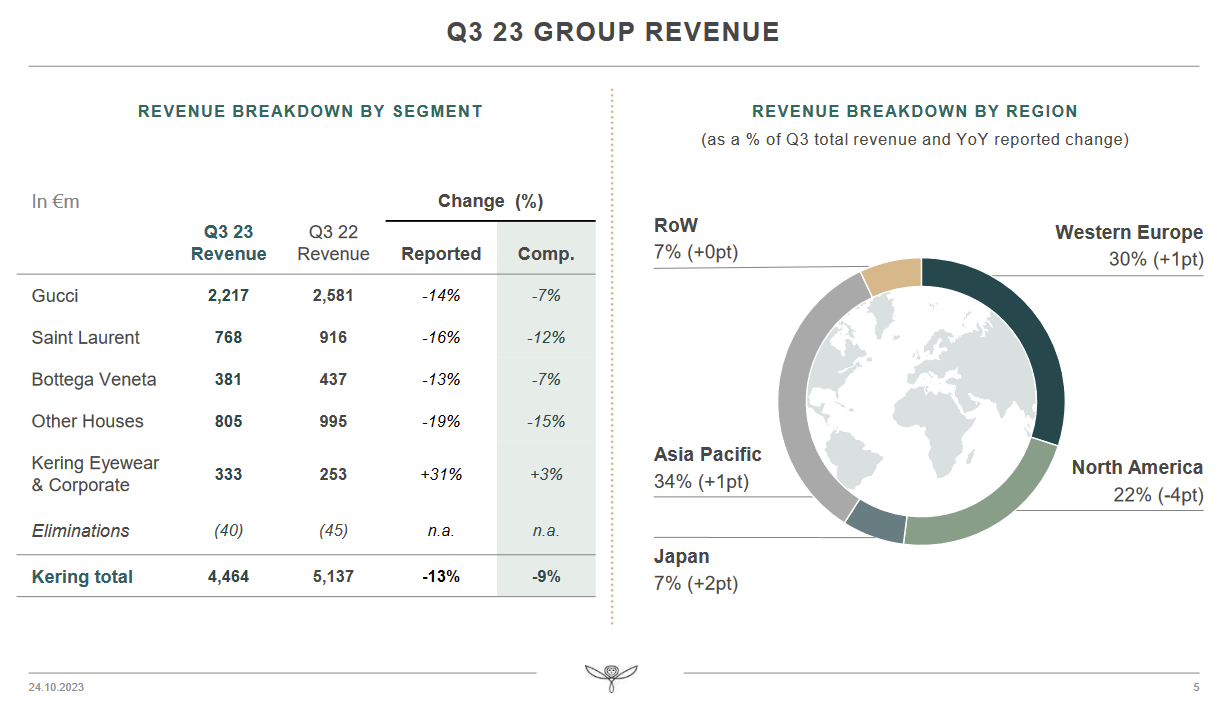
Total Revenue: Kering reported a total revenue of €4.464 billion for Q3 2023.
Gucci: Experienced a decrease with €2.2 billion in revenue, down 14% as reported and 7% on a comparable basis.
Yves Saint Laurent: Also saw a decrease to €768 million, down 16% as reported and 12% on a comparable basis.
Bottega Veneta: Reported €381 million in revenue, down 13% as reported and 7% on a comparable basis.
Other Houses: Recorded €805 million, down 19% as reported and 15% on a comparable basis.
Kering Eyewear: Continued its growth with €331 million in revenue, up 34% as reported and 2% on a comparable basis.
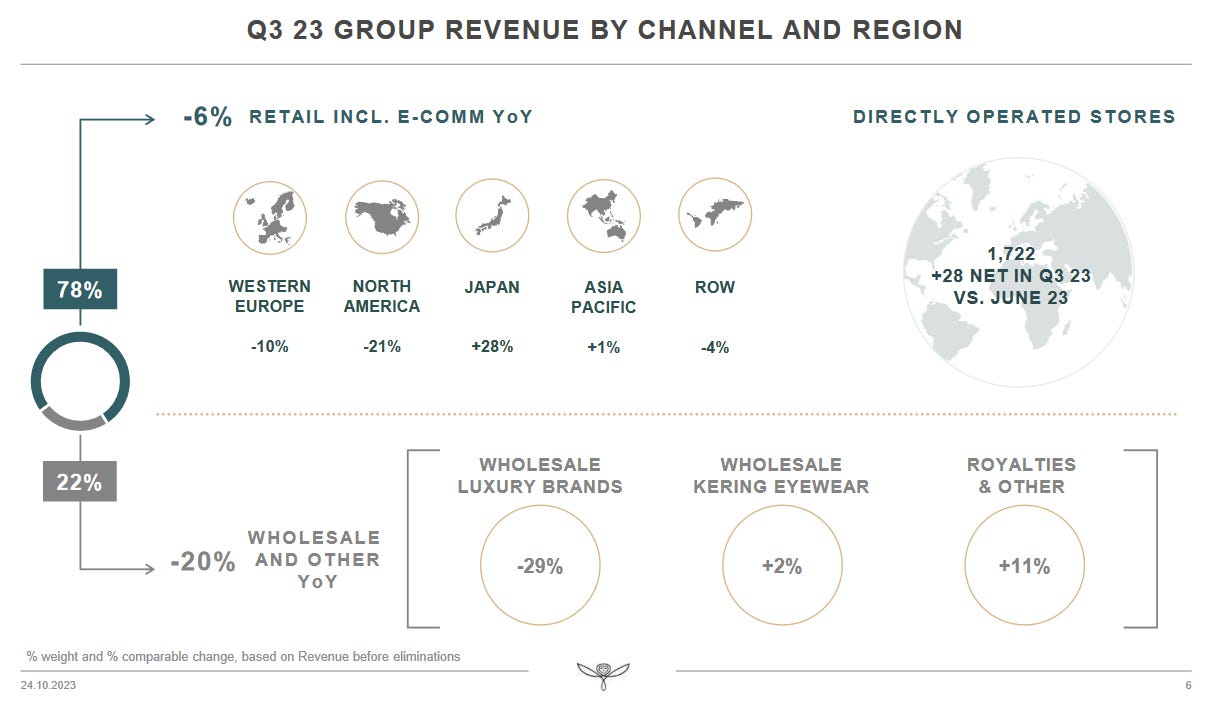
The main reason for Kering's revenue decline in Q3 2023 was attributed to a combination of factors:
Normalization in the Luxury Segment: Kering's revenue was affected by a general trend towards normalization in the luxury market, suggesting a shift in market dynamics following a period of potential growth.
Elevation Strategy: Kering implemented a strategy to elevate its brand prestige and exclusivity by reducing wholesale activities across most of its houses. This often involves limiting the volume of products sold through wholesale channels. The aim is to maintain a sense of exclusivity and luxury.
Wholesale Reduction: Kering's increased control over distribution has led to a significant decline in wholesale, particularly in the U.S. The company is committed to further tightening distribution, which is expected to yield long-term benefits.
Adverse Macroeconomic Factors: The revenue was affected by a challenging macroeconomic backdrop, which comprises external economic factors that can influence consumer spending and market dynamics.
Regional Trends: Different regional trends also contributed to the revenue decline. There were sequential softening in Western Europe and Asia Pacific, subdued performance in North America, and mixed results in other regions.
Foreign Exchange (FX) Impact: Negative contribution from foreign exchange rates represented a material headwind, impacting the revenue figures when converted back to euros.
Strategic Developments and Acquisitions:
Kering Beauté: On June 26, 2023, Kering Beauté strategically expanded its luxury portfolio by acquiring Creed, a prominent player in the high-end fragrance market, for over €250 million. This acquisition significantly enhances Kering's scale and financial profile.
Kering Eyewear: In order to solidify its position in the luxury eyewear industry, Kering Eyewear acquired UNT on June 30, 2023. UNT is a crucial supplier of high-precision components. This acquisition is in line with Kering's strategy of controlling its supply chain through strategic partnerships with leading manufacturers.
Leadership and Organizational Changes:
CEO of Kering Beauté: Raffaella Cornaggia was appointed as the CEO of Kering Beauté on February 3, 2023, bringing over 25 years of experience in the beauty industry to Kering's executive team. She is set to develop expertise in the beauty category for several Kering brands.
Creative Director of Gucci: Sabato De Sarno was appointed as the Creative Director of Gucci on January 28, 2023. His experience from leading fashion houses is expected to guide Gucci's creative direction across various collections.
During the first half of 2023, Kering experienced modest growth, with some brands such as Yves Saint Laurent and Kering Eyewear showing strong performances. However, in the third quarter, the group faced declines in several key segments, including Gucci, Yves Saint Laurent, Bottega Veneta, and Other Houses, despite continued growth in the Eyewear segment. These results reflect the dynamic and challenging nature of the luxury market, with varying performances across different brands and market segments.
Investment case
Strong brands
Kering owns some of the most popular and iconic luxury brands in the world, led by its two main brands, Gucci and Saint Laurent. Both brands consistently rank among the top in fashion rankings for awareness and popularity.
Kering's competitive advantage in the luxury market is largely due to its strong brand portfolio, particularly its flagship brands Gucci and Saint Laurent (Yves Saint Laurent). These brands contribute significantly to Kering's revenue and bolster its overall brand equity and market positioning. Here is a closer look at each:
Gucci
Brand Heritage and Identity: Founded in 1921, Gucci has a rich heritage that blends Italian craftsmanship with a modern aesthetic.
Innovation and Creative Leadership: Gucci is known for its double 'G' logo and iconic green-red-green stripe, and its identity is rooted in luxury, quality, and a flair for bold fashion statements. Under the creative direction of Alessandro Michele since 2015, and more recently with the appointment of Sabato De Sarno, Gucci has undergone a renaissance. Michele's vision revitalized the brand and appealed to younger consumers, bringing a new era of maximalist aesthetics. Gucci is known for its innovative designs that blend historical references with contemporary culture.
Market Positioning: Gucci operates in the high-end luxury segment, catering to an upscale consumer base. Its products range from apparel and leather goods to accessories and fragrances, each embodying the brand's unique style and quality.
Global Reach and Cultural Impact: The brand has a global reach and cultural impact. Gucci has a vast global presence, with a wide network of boutiques and a strong digital footprint. The brand has maintained cultural relevance and appealed to diverse consumer groups worldwide through collaborations, celebrity endorsements, and digital marketing.
Yves Saint Laurent (Saint Laurent)
Brand Legacy and Evolution: Saint Laurent has been synonymous with modernity and fashion-forward thinking since its establishment in 1961 by Yves Saint Laurent and Pierre Bergé. The brand is renowned for its elegant, sophisticated style and has been credited with several fashion innovations.
Creative Renaissance: Under the creative direction of Anthony Vaccarello, Saint Laurent has continued to build on its legacy while infusing modernity and relevance. Saint Laurent is recognized for its modern and elegant designs that uphold the brand's iconic French aesthetic.
Diverse Product Portfolio: The product portfolio is diverse, including ready-to-wear, leather goods, shoes, and accessories. The brand is especially renowned for its well-tailored women's suits, leather jackets, and iconic bags.
Strategic Expansion and Growth: Saint Laurent has experienced substantial growth in recent years, expanding its global retail presence and enhancing its digital strategies. Saint Laurent has successfully expanded into new markets and demographics, particularly attracting younger luxury consumers.
Brand Equity and Market Positioning: The brand's equity is based on its ability to combine traditional luxury with contemporary fashion, positioning itself as a luxury brand with a unique style and heritage that appeals to a discerning customer base seeking quality and exclusivity.
Gucci and Saint Laurent are important brands in Kering's portfolio, not only because of their financial contributions but also due to their strong brand identities and heritage. These brands' ability to innovate while staying true to their roots has allowed Kering to maintain a formidable position in the luxury market. Their global reach, cultural impact, and strong market positioning underpin Kering's overall brand equity and help attract a diverse and loyal customer base.
Luxury market
The luxury market in which Kering operates is a multifaceted and complex landscape, characterized by robust growth and a competitive environment. In 2022, this market generated revenue estimated to be between €350-390 billion, reflecting the expansive nature of the luxury sector. Expected to grow at an annual rate of 5-7%, this market has maintained a steady growth trajectory, similar to the trends observed over the last 15 years.
The global market for luxury consumer goods is dominated by a few large global players, often part of multi-brand groups like Kering itself, alongside numerous smaller independent players. Kering shares this competitive space with other major luxury conglomerates such as LVMH, Richemont, Hermès, Chanel, and Prada. It is worth noting that in 2022, the ultra-luxury segment performed strongly, seemingly insulated from inflationary pressures and broader macroeconomic challenges.
The luxury market includes several product categories, each contributing significantly to the overall market size. For example, in 2022, apparel accounted for 21-27% of the luxury market, with Kering's brands, such as Gucci, Saint Laurent, and Alexander McQueen, playing a pivotal role. Leather goods, another dominant category estimated at €75-80 billion, are crucial for Kering through its brands, such as Gucci, Saint Laurent, and Bottega Veneta. The shoe category generates an estimated revenue of €30 billion and Kering's brands make significant contributions to this sector. In 2022, the watch sector rebounded remarkably to €50 billion, with Kering's participation through brands like Gucci Timepieces and Boucheron. The jewelry segment had a successful year, with Kering's presence marked by brands such as Boucheron and Pomellato. It is important to note that all evaluations are objective and supported by evidence. Kering announced the creation of Kering Beauté to expand its presence in the €55-70 billion perfumes and cosmetics industry. Kering Eyewear is a significant player in the €22 billion 'Other' category, which includes eyewear and textile accessories.
Since 2021, the American continent has become the world's largest luxury consumer goods market, with robust performance in secondary cities and major regions like New York and Miami. In 2022, Europe remained resilient despite challenges such as the war in Ukraine, buoyed by spending from US and Middle Eastern consumers. Trends in the Asia-Pacific region were mixed, with Southeast Asia showing strong growth while Mainland China faced hurdles due to its zero-COVID policy.
In terms of sales by nationality, American consumers have surpassed the Chinese since 2021. The Chinese market, which was affected by lockdowns and closed borders, may experience a resurgence if the country reopens in 2023 as expected.
The distribution channels in the luxury market have also undergone changes. In 2022, the retail channel accounted for 50% of in-person sales, emphasizing the significance of a strong network of directly operated stores for luxury brands. Kering generates a higher proportion of its sales from its directly operated stores, aligning with its strategic aim of expansion. The wholesale channel, important for categories like ready-to-wear and watches, represents about 50% of the total market. However, Kering has strategically reduced its dependence on this channel. E-commerce, which doubled in 2020, accounts for 21% of the luxury market, a segment where Kering’s brands have been increasingly assertive.
Kering operates in a dynamic and growth-oriented luxury market that spans diverse product categories and regions. Its strategic focus on expanding direct retail and e-commerce presence, along with a diverse product portfolio, positions it well in a market shaped by changing consumer preferences and technological advancements.
The luxury market outlook, as analyzed by J.P. Morgan Research, reveals several key dynamics:
Consumer Spending Shift in the U.S.: There is a reduction in spending on non-essential goods in the U.S., impacting luxury sales. This trend is attributed to consumers using up the excess savings accrued during the pandemic, with a forecast that these savings will be fully depleted by Q3 2023.
China's Reopening as a Positive Influence: The reopening of China is seen as a significant positive driver for the luxury sector, with Chinese consumers being major contributors to luxury spending. Post-pandemic "revenge spending" and high saving rates are fueling domestic luxury sales in China.
Brand Momentum and Consumer Preferences: The impact of China's reopening is expected to vary depending on specific brand momentum. Consumers are likely to prioritize brands and products they most desire. High-value items and coveted brands might be more protected against inflation, with consumers possibly favoring hard luxury items like watches and jewelry as attractive investments.
Increased Marketing Efforts by Luxury Brands: In response to challenging market conditions, luxury brands are likely to increase their marketing efforts to maintain and drive brand momentum, raising questions about the necessary investments to engage increasingly demanding consumers
These findings suggest a multifaceted and dynamic environment in the luxury industry, shaped by worldwide economic factors, consumer actions, and brand-specific trends.
Stock valuation
Kering's outlook for 2023 seems modest due to various challenges, but there is an anticipation of a robust recovery in 2024. Analyzing the broader market trends and expectations, Kering's sales revenue is projected to grow until 2027 at a compound annual growth rate (CAGR) of 7.3%. Additionally, its EBIT (Earnings Before Interest and Taxes) and normalized Net Income are forecasted to grow even more robustly, at rates of 10.1% and 11.8%, respectively. These projections are significant indicators of Kering's potential for financial growth and recovery.
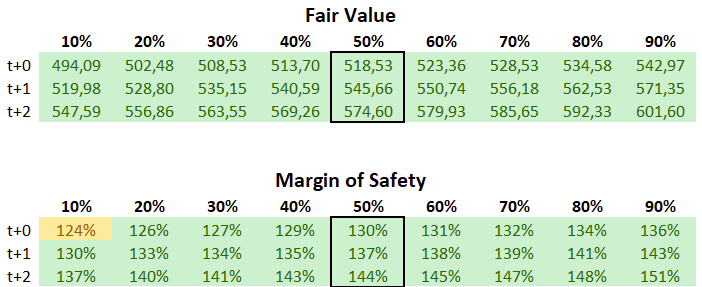
Examining the intrinsic value of Kering's stock, Discounted Cash Flow (DCF) calculations, based on the aforementioned growth rates, suggest an intrinsic value of approximately €519 per share. This valuation is significantly higher than the current stock price of around €399, indicating a potential undervaluation in the market. The calculated margin of safety, which is the difference between the intrinsic and market values, is approximately 130%. This provides a cushion against market volatility or estimation errors.
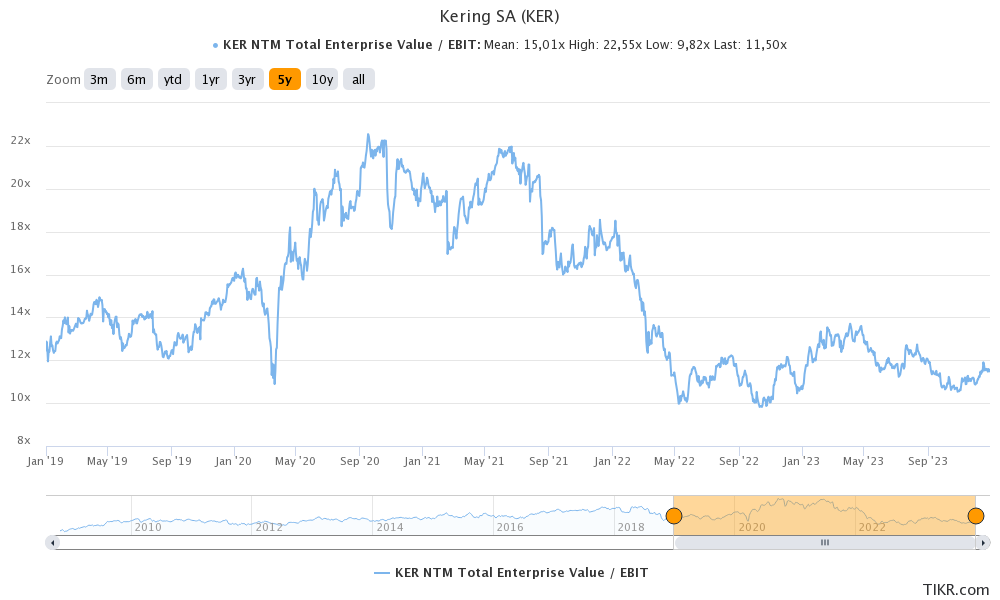
To support this valuation thesis, we considered other financial metrics. Over the past five years, the NTM Enterprise Value to EBIT (NTM TEV/EBIT) ratio, which is a measure of a company's valuation, averaged around 15x. Currently, Kering's ratio stands at about 11.5x, which is comparatively lower than historical averages, suggesting undervaluation. When compared to its major competitors, LVMH and Hermès, Kering's stock trades at the most modest multiple of 11.5x. In contrast, LVMH and Hermès trade at higher multiples of 16.5x and 32.3x, respectively. Although LVMH and Hermès have exhibited stronger performances in the current year, which partly explains their higher valuation multiples, Kering's lower multiple further supports the argument for its stock being undervalued.
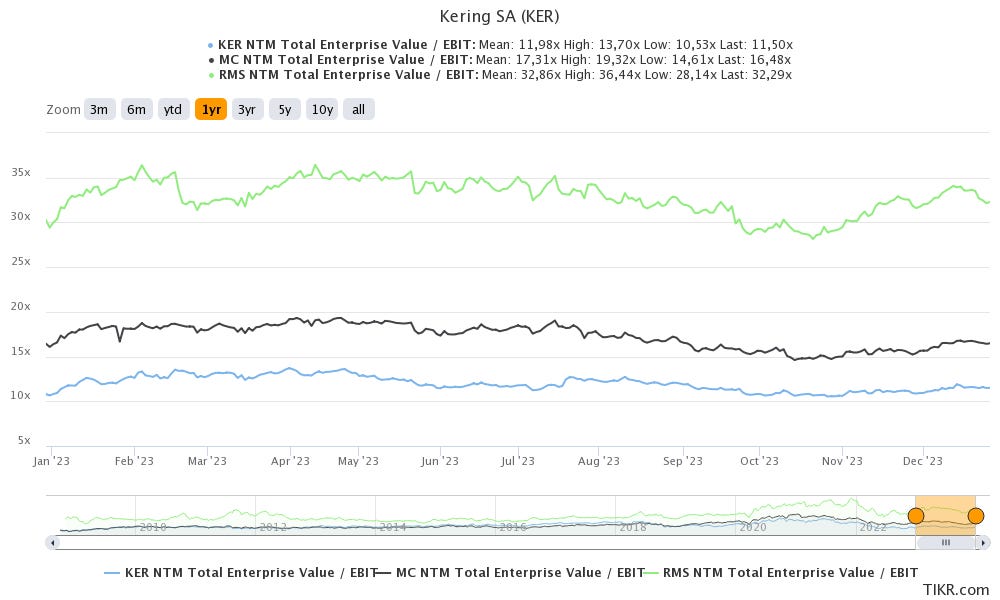
In summary, Kering is expected to recover strongly in the following year despite facing challenges in 2023. The company has strong growth projections in key financial metrics. The current valuation of Kering's stock, when analyzed through various financial models and compared with industry peers, presents an attractive investment opportunity, given its potential undervaluation in the market.
Conclusion on Kering
Kering underwent a challenging transformation to become a pure luxury player. The strategy has shown its merits through consistent margin improvement over the years. However, this transformation has not yet resulted in the expected level of growth when compared to its peers in the luxury sector. However, the luxury market's strength and resilience, combined with Kering's strategic direction, suggest a promising future. It is expected that Kering will return to a more robust growth trajectory from 2024 onwards.
The potential of Kering's strong brand portfolio cannot be overstated. Each brand under Kering's umbrella has a distinct identity and appeal, which holds considerable potential for growth and market penetration. Kering has been expanding its portfolio through strategic acquisitions, similar to LVMH's approach, to strengthen its position in the luxury market.
The company's business model and strategy are aligned with a long-term vision of success. Like LVMH, Kering places significant emphasis on the autonomy of its various houses or brands, ensuring that each retains its unique character and appeal. This approach fosters creativity and brand loyalty while allowing for tailored strategies that resonate with each brand's specific audience.
From an investment perspective, Kering's stock appears undervalued at the moment. This assessment considers the company's future growth prospects, historical financial performance, and a comparison with its industry counterparts. Based on Kering's strategic initiatives, the intrinsic strength of its brands, and the overall robustness of the luxury market, the stock presents an attractive opportunity for investors seeking long-term value. As Kering refines its operations and expands its brand portfolio, the company is well-positioned to capitalize on the lucrative opportunities in the global luxury market.
Disclaimer: The information provided in this publication is for educational and informational purposes only and does not constitute financial advice. The content is solely reflective of my personal views and opinions based on my research and is not intended to be used as a basis for investment decisions. While every effort is made to ensure that the information is accurate and up-to-date, the writer makes no representations as to the accuracy, completeness, suitability, or validity of any information in this post and will not be liable for any errors, omissions, or delays in this information or any losses, injuries, or damages arising from its display or use. All readers are advised to conduct their own independent research or consult a professional financial advisor before making any investment decisions. The author is invested in Kering.