


The Rise of Standard Oil: A Monopoly in the Making
Historical Background: An Oil Boom and a Bold Vision
In the mid-19th century, the discovery of petroleum in northwestern Pennsylvania set off a frenzy. Edwin Drake’s 1859 oil strike in Titusville sparked an oil rush, with drillers and speculators pouring into the “oil regions” in search of black gold. Kerosene from refined oil quickly became a popular lamp fuel, dubbed “the poor man’s light,” and demand surged. But the early oil industry was chaotic – easy to enter, overcrowded with drillers, refiners, and wildcat entrepreneurs. Prices whipsawed with each new gusher or glut of oil. Into this volatile scene stepped a young Cleveland bookkeeper-turned-oil-refiner named John D. Rockefeller.
Rockefeller had a reputation for precision, thrift, and relentless focus on efficiency. By the early 1860s, he was operating a small refinery in Cleveland with partners. He abhorred waste and believed success lay in wringing savings from every process. For example, Rockefeller even built his own barrel-making factory and purchased forests of oak, drying the wood in kilns to reduce shipping weight before crafting it into barrels. Such obsessive cost-cutting (what we today call vertical integration) gave him an edge in the low-margin oil business. In 1865, at just 24, Rockefeller bought out his partners to gain full control of the refinery, reinvesting profits to expand further. He brought in new partners like Henry M. Flagler and by 1870 he took a daring leap: incorporating the Standard Oil Company of Ohio with $1 million in capital.
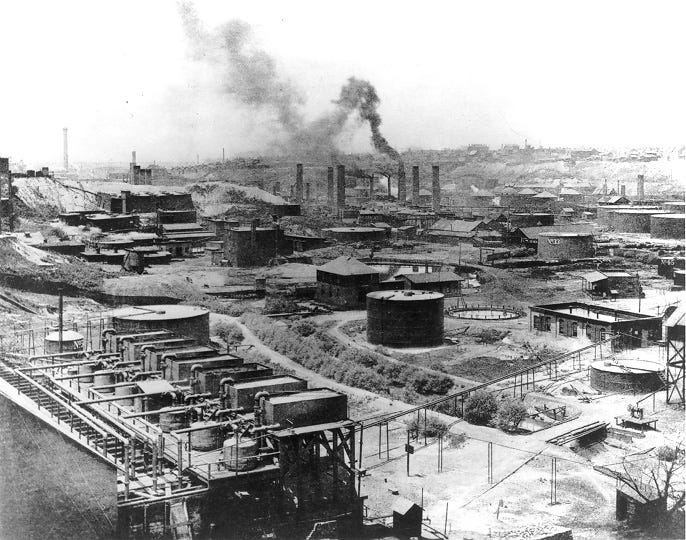
On January 10, 1870, Standard Oil of Ohio was born, with Rockefeller and a handful of associates (his brother William, Henry Flagler, chemist Samuel Andrews, Stephen Harkness, and O.B. Jennings) as the principal shareholders. At its founding, Standard Oil controlled only about 10% of U.S. oil refining, but Rockefeller’s ambitions reached far beyond Cleveland. He looked at the oil industry and saw chaos: too many players, wild price swings, and rampant inefficiency. Small refiners would wildly undercut prices in desperate bids to stay afloat, often driving prices below production cost and jeopardizing even well-run businesses. To Rockefeller, this was madness. Free competition, he felt, was ruining the industry. He believed the solution was to consolidate – to replace competition with cooperation under one large enterprise (ideally, his own). “The day of combination is here to stay,” Rockefeller proclaimed, insisting that rationalization by a few strong firms (or just one) would stabilize the market and eliminate waste. As he later framed it, Standard Oil’s rise was “the battle of the new idea of cooperation against competition”. In other words, Rockefeller believed competition was destructive – and he set out to prove that one company, efficiently run, could provide oil more reliably and cheaply than a swarm of competing firms.
Building an Oil Empire: Standard Oil’s Strategy and Tactics
Rockefeller’s vision for Standard Oil was nothing less than industry domination, and he pursued it with methodical and sometimes ruthless strategy. The 1870s saw Standard Oil grow from a regional refiner to America’s first great industrial monopoly. How did Rockefeller do it? Through a combination of shrewd business tactics that squeezed out rivals and tightened Standard Oil’s grip on every facet of the trade.
1. Aggressive Acquisitions (Horizontal Integration): Rockefeller’s first move was to buy out his competition, especially in his home base of Cleveland. In 1871–72, he embarked on what came to be known as the “Cleveland Massacre.” Using a mix of persuasion, secrecy, and pressure, Standard Oil absorbed 22 of Cleveland’s 26 rival refiners in just a few months. Rockefeller often approached the owners personally, offering a stark choice: join Standard Oil as partners and swap your refinery for Standard stock – or sell out for cash. If they refused, they faced a price war or isolation that would likely ruin their business. Many chose to sell. By March 1872, after this buying spree, Standard Oil controlled about 25% of the entire U.S. oil refining capacity. Rockefeller justified these takeovers as inevitable. To him, the weaker refiners were destined to fall. Merging them into Standard Oil wasn’t malevolence; it was “survival of the fittest” in his mind – with Standard being the fittest. Those who sold to Rockefeller were actually offered fair, even generous, deals in many cases (some who accepted Standard stock became fabulously wealthy). But any who resisted could be crushed. One way or another, Rockefeller eliminated excess competition by absorbing it.
2. The South Improvement Company Scheme (Railroad Rebates): While Rockefeller was consolidating Cleveland, he also struck a notorious deal that has gone down in infamy. In late 1871, Standard Oil joined a secret alliance with major railroads dubbed the South Improvement Company. The plan – engineered with railroad titan Thomas Scott of the Pennsylvania Railroad – was to form a cartel of refiners (led by Standard) and railroads that would fix transportation rates and oust outside competitors. Under this scheme, railroads agreed to give deep rebates (discounts) on oil shipments to Standard Oil and a few allies. Even more nefariously, the plan included “drawbacks”: for every barrel of oil shipped by an independent refiner outside the alliance, the railroads would secretly kick back an equal rebate to Standard Oil. In effect, Standard’s rivals would be subsidizing their own eventual doom – every time a competitor paid full freight, Standard Oil would pocket a reward. This cozy arrangement was made in the shadows, and no competitor was meant to find out. But word leaked early in 1872. When independent oil men in Pennsylvania’s Oil Regions discovered that Standard Oil had conspired to hike their freight rates and tax their shipments, outrage erupted. Producers and refiners banded together in protest, newspapers blasted the “oil conspiracy,” and even state legislators took action. The Pennsylvania legislature swiftly revoked the charter of the South Improvement Company, killing the scheme before it officially carried out a single shipment.
Rockefeller later insisted he hadn’t invented the South Improvement plan (true – it was largely the railroads’ idea) and that no oil was ever shipped under it. But his participation in this secret deal – and his failure to explain himself publicly – badly tarnished his reputation. “Our silence encouraged the wildest romancers to spread wild tales about us,” Rockefeller lamented of the South Improvement fiasco. Indeed, this episode was the first time the broader public learned that Standard Oil was scheming to dominate the industry. The damage was done: Rockefeller was cast as the archetypal greedy monopolist in the public eye. Yet, even as the South Improvement Company collapsed in disgrace, Rockefeller coolly turned the situation to his advantage. He had leveraged the threat of the deal to scare many refiners into selling out to Standard before the plan blew up. And once competitors saw the kind of influence Standard wielded with the railroads, more of them were willing to surrender. Rockefeller and Flagler pressed on, quietly and relentlessly buying up rivals across the Northeast and beyond. By 1879, Standard Oil was refining 90% of all oil in the United States, an astonishing market share that made it the first great industrial monopoly in the world.
3. Controlling the Supply Chain (Vertical Integration): Gaining a stranglehold on refining was just the beginning. Rockefeller understood that to truly dominate the oil industry, Standard Oil needed to control every link of the chain – from the wells and pipelines that brought crude out of the ground, to the railroads and ships that transported petroleum, to the retail outlets that sold finished products like kerosene. During the 1870s, Standard Oil aggressively expanded into these verticals. It bought up pipeline networks to transport crude oil, often cutting off competitors’ access to supply. In 1874, when an ambitious rival tried to build a pipeline across Pennsylvania to break free of Standard’s control, Rockefeller’s agents bought up strategic land along the route to block construction. He even resorted to bribing Pennsylvania state legislators to secure his pipeline dominance. Eventually, a deal was struck that left Standard owning nearly every major oil pipeline in the country – the arteries of the industry flowed into Standard Oil’s hands. With pipelines under Standard’s control, independent refiners found it ever harder to get their crude to market.
At the same time, Standard Oil struck exclusive deals for preferential railroad service beyond the short-lived South Improvement plan. For example, as early as 1868, Rockefeller had negotiated secret freight rates like a mere $0.42 per barrel on the Lake Shore Railroad (part of New York Central) – a 71% discount off the public tariff, in exchange for huge volume shipments and self-loading of tank cars. Smaller refiners couldn’t hope to match that volume, so they paid higher rates or were outright denied service. These transport deals helped Standard ship oil cheaper than anyone else, driving its refining costs down and profits up. From 1865 to 1870, Standard’s efficiencies and rebates contributed to the price of refined kerosene plummeting from 58 cents to 26 cents a gallon – a boon to consumers, but a warning shot to competitors that Rockefeller could undercut them at will.
Standard Oil’s vertical integration went beyond pipelines and railroads. The company manufactured its own barrels, ran its own tanker ships and railroad tank cars, and built a marketing apparatus to get kerosene to every city, town, and village. By the 1880s, Standard Oil was truly an empire unto itself. It pumped oil, refined it, shipped it, and sold it. Competitors joked (nervously) that the only thing Standard didn’t control was the oil still in the ground – and they were working on that too. Indeed, Standard bought up oil wells and production companies when advantageous, though its primary strength was always refining and distribution. This level of control allowed Rockefeller to weather price crashes (he’d simply store oil in his vast tank farms to wait for a better day) and to dictate terms to anyone who hoped to do business in oil. Vertical integration meant that if you drilled oil, you likely had to sell to Standard (or ship through their pipes); if you sold kerosene in your store, you bought from Standard; and if you competed with Standard, you faced a behemoth that could operate on slimmer margins than you could imagine.
4. Ruthless Competitive Tactics: With horizontal and vertical integration came the ability to deploy predatory tactics against any remaining competitors. Standard Oil became infamous for strategies such as predatory pricing – temporarily slashing kerosene prices in a region where a rival tried to compete, even selling below cost, to ensure customers would stick with Standard. The rival, bleeding cash, would soon give up or sell out, at which point Standard would quietly raise prices again to recoup its “losses”. The company even set up front companies that appeared to be independent refiners or oil distributors, complete with different brand names, to give customers and regulators the illusion of competition – when in fact Standard Oil owned them all. By the 1880s Standard divided the U.S. into marketing districts and, as one strategy to boost demand, gave away free or cheap oil lamps to encourage people to switch from candles to kerosene (which, of course, Standard would supply). It was said that Standard Oil agents and salesmen reached into the tiniest hamlets, ensuring that even a remote general store was likely selling Standard’s “Solar Oil” or “Water White” lamp oil. In many towns, rival oil sellers couldn’t survive Standard’s onslaught of low prices and locked-up distribution channels.
Despite these heavy-handed tactics, Rockefeller often argued that Standard Oil earned its dominance by being more efficient and providing a better, cheaper product. It’s true that consumers benefited in the early years from Standard’s cost-cutting: poor families could afford kerosene lighting as prices fell. As Rockefeller liked to say, Standard Oil’s mission was to bring light to the poor at the lowest price. But competitors and critics saw a darker side: once Standard had crushed its rivals, it could exercise monopoly power – and evidence suggested it eventually did. By the 1890s, with competition minimal, Standard Oil’s pricing for kerosene was creeping up again, fattening profit margins beyond what a truly competitive market would allow. The company’s hardball methods also bred intense resentment. Independent oil men, small producers, and the public increasingly denounced Rockefeller as a tyrant monopolist who destroyed others’ livelihoods to build his empire.
The Standard Oil Trust: Monopoly Power in the Gilded Age
By the early 1880s, Standard Oil’s dominion was nearly complete. To manage this sprawling empire of dozens of subsidiaries across many states, Rockefeller and his partners pioneered a new form of corporate organization: the Trust. On January 2, 1882, they secretly created the Standard Oil Trust, an entity that would formalize their monopoly power. Under this arrangement, all the stock of Standard Oil of Ohio and its myriad affiliates was placed “in trust” with a board of nine trustees (Rockefeller and his inner circle) who would centrally manage the business. Every shareholder of the various companies received Trust certificates in exchange for their stock, and the trustees now effectively controlled all Standard Oil properties and profits. This clever legal device allowed Standard Oil to operate as a unified monopoly while skirting state laws that forbade one corporation from owning another across state lines. The Standard Oil Trust was capitalized at $70 million (an enormous sum for the time, though Rockefeller’s people claimed the true value was closer to $200 million). Rockefeller himself held the largest share – about a third of the Trust’s certificates – but importantly, he was still one among several powerful partners. He chaired the trust as “primus inter pares,” or first among equals. Decisions were often made cooperatively by committees, and Rockefeller, while dominant, couldn’t unilaterally dictate every move.
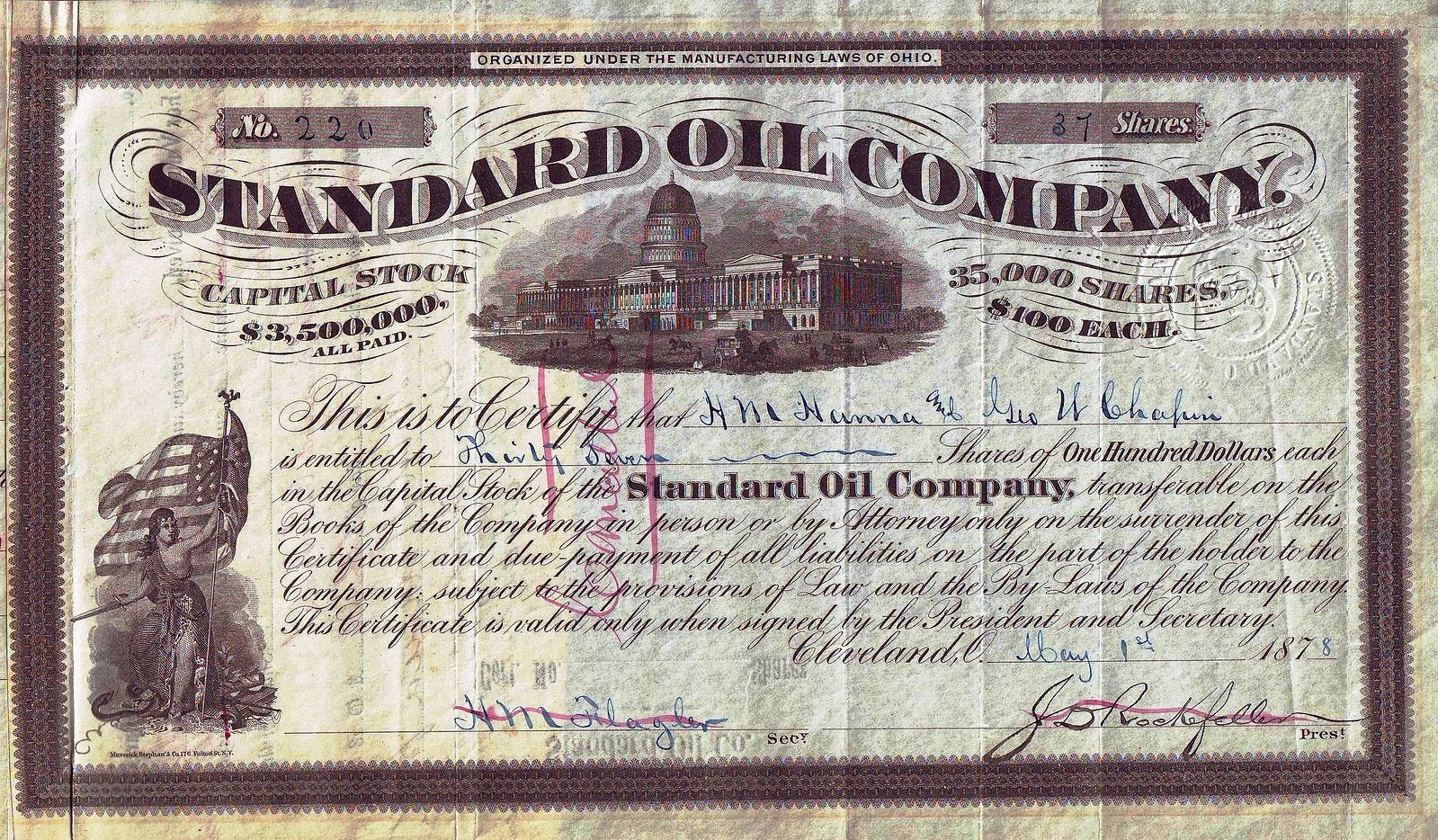
Under the Trust, Standard Oil entered its golden age of monopoly. By 1885, the company moved its headquarters to a towering new building at 26 Broadway in New York City, symbolically placing the center of American oil power in the nation’s financial capital. Standard Oil of New Jersey was chartered as a new legal shell to hold many of the assets (New Jersey had lenient laws permitting holding companies). At its peak, Standard Oil controlled around 90% of U.S. oil refining and 90% of oil sales by the late 1880s and early 1890s. It produced most of the world’s kerosene and by 1882 had 4,000 miles of pipelines and over 100,000 employees on its payroll – a scale unprecedented in business. In 1904, one analysis found Standard Oil refined 91% of America’s oil and was marketing 85% of the final oil products sold to consumers. It is hard to overstate just how dominant Standard Oil was; the company was literally synonymous with oil in the late 19th century.
To maintain this supremacy, Standard Oil continued to innovate in efficiency. The company established research labs and hired chemists to figure out uses for every byproduct of petroleum – nothing went to waste if they could help it. (One notable success: Standard Oil’s scientists found a way to remove the sulfur smell from cheap “sour crude” from Lima, Ohio, turning worthless smelly oil into valuable fuel.) Standard’s managers also built an elaborate distribution system that extended into almost every American town by the turn of the century. Fleet of horse-drawn tank wagons bearing the Standard Oil logo would deliver kerosene to general stores and homes nationwide. In fact, by 1904, it was reported that Standard Oil’s tank wagons served 80% of American towns, bringing oil directly to consumers. This penetration into even the smallest markets was a huge competitive advantage, but it came at a public relations cost. Standard Oil’s salesmen often pressured local retailers to stock only Standard’s products, threatening to undercut them if they dared sell a competitor’s oil. Such tactics bred resentment among shopkeepers and the public, who began to view Standard Oil not as a benevolent bringer of light, but as a bullying giant intent on strangling all alternatives.
Indeed, by the dawn of the 20th century, Standard Oil had become the most hated company in America. Farmers and laborers who once cheered falling kerosene prices now muttered about being at Rockefeller’s mercy. Competing oil firms (the few that remained) and would-be entrepreneurs clamored that they had no chance to succeed against the Standard behemoth. Even other industries and politicians grew wary of the outsized power of Standard Oil, which by now had tentacles in banking, railroads, and politics. Critics accused Standard Oil of wielding its wealth to influence lawmakers – a charge not without merit, as the company had quietly lobbyed and bribed for favorable treatment for years.
The Gilded Age in which Standard Oil thrived was an era of minimal regulation, but it wasn’t completely lawless. By the 1880s, populist anger at monopolies led many states to pass antitrust laws of their own, and Congress to debate national legislation. Standard Oil, being the largest and most egregious monopoly, became the prime target – the “Trust” that gave all trusts a bad name. In 1890, the U.S. Congress passed the Sherman Antitrust Act, which aimed to outlaw business combinations in “restraint of trade.” It was a broad, vague law at first, but it laid a legal foundation for challenging Standard Oil’s supremacy. State after state also sued Standard Oil-affiliated companies for violating local monopoly laws. Between 1887 and 1904, at least 10 states (and the Oklahoma territory) launched 33 lawsuits against parts of the Standard Oil Trust. Standard Oil would lose many of these cases in court – for instance, Ohio’s Supreme Court ordered the dissolution of Standard Oil of Ohio in 1892 for violating its state charter. But Rockefeller’s team was adept at evading or delaying enforcement. They would dissolve one entity and transfer assets to another, shift operations to a friendlier jurisdiction, or simply appeal and stall. For a long time, Standard Oil’s legal Waterloo never came; the hydra-headed trust seemed untouchable, even as its public image grew uglier.
Public Backlash and the Fall of Standard Oil
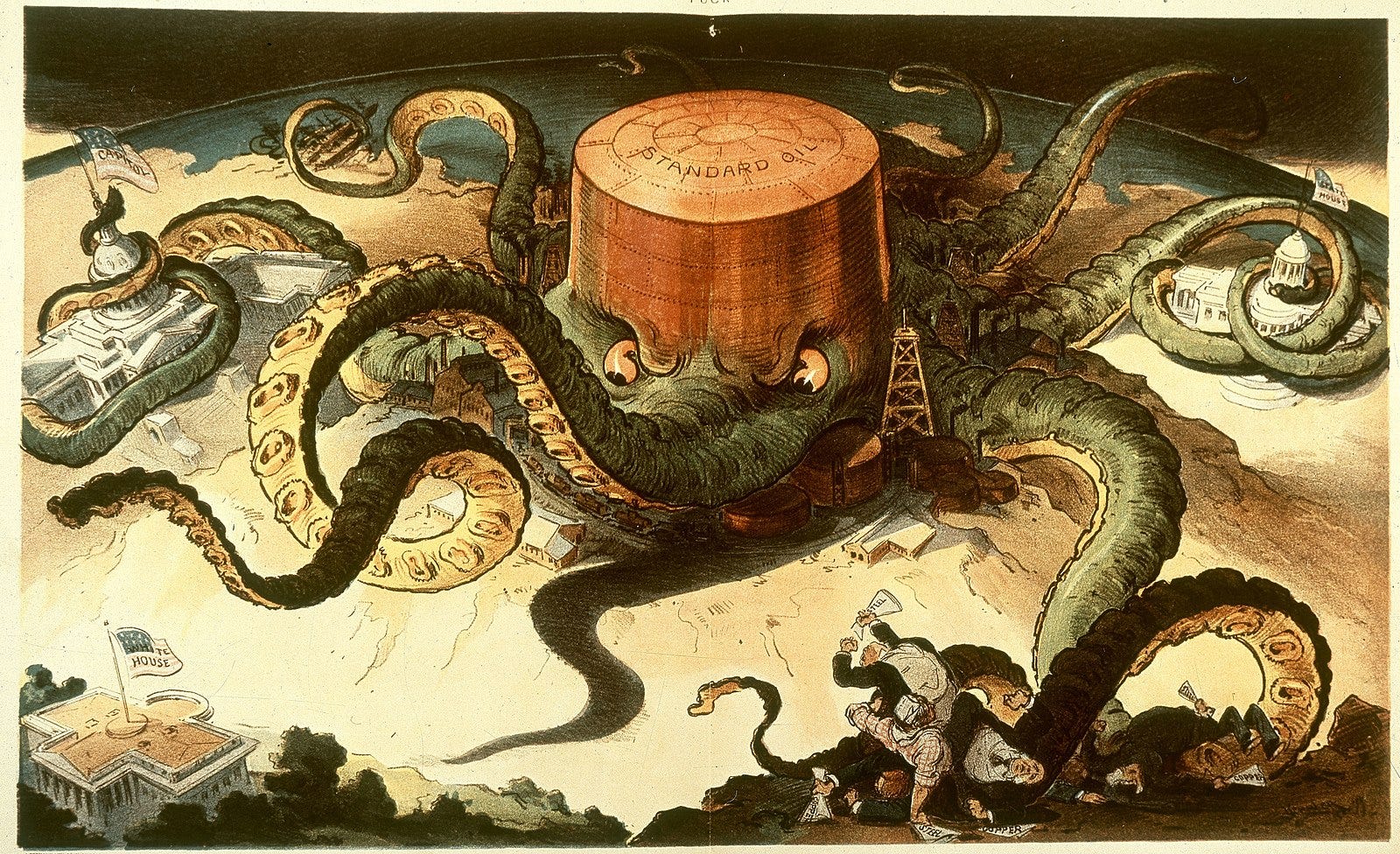
By the turn of the 20th century, Standard Oil had come to symbolize the threat of unchecked monopoly power in America. Public anger toward Rockefeller’s empire reached a fever pitch. A famous 1904 political cartoon in Puck magazine, titled “Next!”, depicted a gigantic Standard Oil tank as a malevolent octopus, its tentacles wrapped around the copper and steel industries, a state house, the U.S. Capitol, and even reaching out to grasp the White House. This vivid image captured the popular fear that Standard Oil’s influence was strangling not only competitors but also corrupting government and society. Such fears were not unfounded. Standard’s tentacles did reach into politics (the company had allies in Congress and state legislatures), and its dominance in oil was essentially complete. The “octopus” cartoon and others like it cemented in the public’s mind that Standard Oil was an enemy of the public interest – a greedy monopolist that had to be tamed.
Around the same time, investigative journalists known as “muckrakers” took on Standard Oil with a vengeance. The most famous of these was Ida M. Tarbell, a soft-spoken but relentless reporter whose father had been driven out of the oil business by Standard years before. In 1902, Tarbell began publishing a painstakingly researched expose, The History of the Standard Oil Company, as a series of articles in McClure’s Magazine. Over two years, Tarbell laid out in cool, factual detail the underhanded tactics Rockefeller had used to build Standard Oil’s monopoly. She revealed the secret railroad rebates and freight discounts that had undercut competitors (in fact, such rebates had been outlawed by the Interstate Commerce Act of 1887, yet Standard got away with them). She described how Rockefeller would ruthlessly force competitors to “sell or perish,” documenting instance after instance of refineries that yielded to Standard’s pressure. Tarbell even uncovered Standard’s use of corporate espionage to spy on rivals and its bribery of public officials to secure favorable treatment. Her reportage portrayed Rockefeller as a cunning, Machiavellian figure – “Miss Tarbarrel” and “that poison woman,” Rockefeller muttered in private, dismissing Tarbell’s work. But the public was riveted. Tarbell’s writings galvanized anti-monopoly sentiment and put Standard Oil on the defensive. For the first time, the full scope of Standard’s secretive operations was illuminated for everyday readers, and it wasn’t a flattering picture. Rockefeller’s denial and silence in face of these accusations only made people more suspicious.
With public opinion turned sharply against the “Mother of Trusts,” the U.S. government was finally spurred to act. President Theodore Roosevelt had built a reputation as a “trust-buster,” and although Roosevelt actually believed in regulating trusts more than breaking them up, he was no friend to Standard Oil. In 1906, Roosevelt’s Justice Department (under Attorney General Frank B. Kellogg) filed a monumental antitrust lawsuit against Standard Oil of New Jersey, the flagship company of the Standard trust. The government’s case argued that Standard Oil was an illegal monopoly in violation of the Sherman Act, using an array of anticompetitive tactics to maintain its dominance. The trial, which took place in 1908, was one of the biggest corporate cases in history up to that point. Over 400 witnesses testified, and a mountain of evidence was presented detailing Standard Oil’s conduct. The findings were damning: the court heard how Standard secured illegal railroad rebates, how it blocked competitors from accessing pipelines, how it conducted industrial espionage, and how it bribed politicians for influence. The prosecution also demonstrated that once Standard had crushed its competition, it had indeed hiked up kerosene prices significantly (46% price increases from 1895 to 1906, generating monopoly profits).
John D. Rockefeller, though technically still president of Standard Oil, had retired from active management in the late 1890s. He did not run the company day-to-day during this trial – that duty had fallen to John D. Archbold and other successors. Rockefeller himself testified via a deposition, claiming Standard Oil succeeded simply because it was more efficient and provided a better product than anyone else. When pressed on specific tactics Standard used to eliminate competitors, the 71-year-old Rockefeller was evasive and often answered that he “could not remember”. The judges, however, were not persuaded by Standard Oil’s defense. In 1909, the trial court ruled against Standard, and in May 1911 the case reached its climax in the U.S. Supreme Court.
On May 15, 1911, the Supreme Court delivered a historic unanimous decision: Standard Oil was guilty of monopolizing the petroleum industry through unreasonable restraint of trade. The court held that Standard Oil’s business practices – its acquisitions, secret deals, and schemes – violated the Sherman Antitrust Act. The Justices ordered that the Standard Oil Trust be dissolved, “to restore competition” in the industry. Specifically, Standard Oil of New Jersey and the other subsidiaries were to be broken apart into independent companies that would compete with each other. In total, the trust’s assets were split into 34 separate companies.
At least, that was the theory. In practice, the breakup was structured in a way that did not devastate Rockefeller or the other Standard Oil stockholders. The Court allowed each Standard Oil shareholder to receive shares in all 34 of the new companies proportional to their ownership. In other words, Rockefeller suddenly found himself not the owner of one giant company, but the owner of pieces of 34 companies – which, collectively, were worth even more on the stock market. Indeed, the breakup of Standard Oil proved a financial windfall for Rockefeller and investors. Freed from the taint of the antitrust trial and able to operate independently, many of the new companies’ stocks soared. By 1913, John D. Rockefeller’s personal fortune had swollen to $900 million (equivalent to about $13–$14 billion today). He is often cited as the richest person in modern history, and the breakup ironically made him richer, not poorer.
What about the oil industry? Initially, the same men remained in charge of the spun-off companies, and old habits die hard. For a few years, the ex-Standard companies still informally cooperated in setting prices, and competition was sluggish. But over time, real competition did emerge. New oil discoveries in Texas, California, and abroad created opportunities for independent oil companies to rise, challenging the dominance of the former Standard empire. And the world was changing: in 1911, kerosene for lamps was no longer the centerpiece of oil demand – electric lights were replacing oil lamps in homes. However, a new age of oil was just beginning: the automobile, powered by gasoline, was on the rise, and gasoline had been a formerly discarded byproduct of kerosene refining. The breakup companies like Standard of New Jersey, New York, California, etc., quickly shifted focus to gasoline, and in the coming decades they became oil giants in their own right, profiting immensely from the car culture. Companies that sprang from the Standard Oil dissolution – with familiar names today like Exxon (Standard of NJ), Mobil (Standard of NY), Chevron (Standard of CA), Amoco (Standard of IN), Conoco (Continental), and Sohio (Standard of OH) – dominated the 20th-century oil landscape. For years they continued to wield significant influence over oil prices and supply, especially as many of them grew into multinational corporations.
The breakup of Standard Oil was celebrated by many Americans in 1911 as a victory of democracy over the trusts. It proved that no private company, not even one as powerful as Standard Oil, was above the law. Ida Tarbell and the muckrakers were hailed for their role in bringing the monopoly to justice. And the government’s success in court validated the Sherman Act, emboldening regulators to go after other monopolies (indeed, just weeks later, the Supreme Court also ordered the breakup of the American Tobacco trust in 1911). Yet the Supreme Court’s ruling also introduced the controversial “rule of reason,” stipulating that only monopolies that acted “unreasonably” to restrain trade were illegal. This somewhat muddled standard would complicate antitrust enforcement in years to come – but there was no doubt that Standard Oil’s conduct was far beyond reasonable.
John D. Rockefeller, for his part, largely stayed out of the limelight after 1911. Having officially retired years earlier, he devoted the rest of his long life (he lived until 1937) to philanthropy and charitable works, giving away hundreds of millions of dollars. He often said that breaking up Standard Oil had been unnecessary – that he had actually done the country a service by building an efficient company. Public sentiment, however, had concluded otherwise: Standard Oil had become the textbook example of why monopolies cannot go unchecked.
Legacy and Lessons of the Standard Oil Story
The saga of Standard Oil left an enduring legacy on both American capitalism and the laws that govern it. In business history, Standard Oil is often held up as a cautionary tale and a source of strategic lessons. On one hand, it demonstrated the incredible power of efficiency, scale, and integration. Rockefeller built Standard Oil into a colossus by driving down costs at every turn, reinvesting profits, and out-managing his competitors. Many of his strategies – controlling supply chains (vertical integration), eliminating redundancies via mergers, and focusing on long-term stability over short-term gains – have been studied and even admired in business schools. Modern corporate giants, from tech firms to manufacturing conglomerates, have employed similar tactics (albeit usually within legal bounds) to gain competitive advantages. The very structure of the modern corporation, with holding companies and complex subsidiaries, owes something to the innovations pioneered by the Standard Oil Trust.
On the other hand, Standard Oil’s story underscored the perils of unfettered monopoly power. The company’s domination of oil markets led to higher barriers to entry for others, stifled innovation from competitors, and concentrated immense power in private hands. This triggered a public and political backlash that still echoes today. The antitrust movement that gained momentum in the early 1900s was fueled by Standard Oil’s example, and it led directly to stronger government oversight of business. After the 1911 breakup, Congress went on to pass the Clayton Antitrust Act (1914) and establish the Federal Trade Commission, both aimed at preventing monopolistic practices and curbing corporate abuses. Antitrust regulation became a permanent feature of the American economic system, with the ghost of Standard Oil haunting any company that grew too dominant in its industry.
Indeed, the Standard Oil case set a precedent. Whenever debates arise about breaking up large companies for being too powerful – from AT&T in the 1980s to Big Tech firms in the 21st century – Standard Oil is inevitably mentioned. The image of Rockefeller’s octopus and the notion that one firm could control an essential resource so completely have become part of the American consciousness. Standard Oil’s breakup demonstrated that the government has both the right and the ability to intervene in the marketplace to promote competition. This principle has arguably kept capitalism more competitive and open than it might otherwise have been.
There is an irony in Standard Oil’s legacy as well. The breakup companies, sometimes called the “Baby Standards,” did very well on their own – so well that over time some of them merged back together. For example, ExxonMobil today is the result of a 1999 re-merger of two of the largest Standard spinoffs (Exxon and Mobil, the former Jersey and New York companies). Similarly, Chevron later acquired Amoco and another Standard descendant. The oil industry is still dominated by a handful of giant corporations – but none has achieved the absolute dominance that Standard Oil did in its heyday. Global competition, new technologies, and vigilant regulators have thus far prevented a single-company repeat of Standard Oil’s feat.
From a narrative standpoint, the rise and fall of Standard Oil remains one of the most dramatic episodes in business history. It’s a story of visionary entrepreneurship and relentless execution, as well as one of greed and ethical quandaries. John D. Rockefeller started as a small businessman with a dream and built an empire that made him richer than any monarch. In doing so, he fundamentally shaped the oil industry and set the template for how a company could achieve global domination of a commodity. But he also provoked the wrath of the public and the government, who ultimately decided that such concentrated power was unacceptable in a free society.
The legacy of Standard Oil is thus twofold: It shows both the potential of brilliant business strategy and the need for checks and balances on that power. Over a century later, we still grapple with finding the right balance between encouraging business innovation and preventing monopolistic abuses – a balance first tested during the age of Standard Oil. The company’s rise and breakup taught Americans that competition, however messy, is vital for innovation and fair prices, and that no empire, no matter how unbeatable it seems, lasts forever once the public and the law unite against it.
In the end, Standard Oil’s journey from scrappy Cleveland refinery to omnipotent trust and its eventual breakup is more than just a chapter in an economics textbook – it’s a vivid saga of ambition, strategy, controversy, and reform. It’s the tale of how one company lit the nation’s lamps and, in doing so, illuminated the need to shine a light on the power of monopolies. And that is why the rise of Standard Oil still captivates us: it’s not only a story of oil, but a story of the tension between unfettered enterprise and the public good, a debate that continues to this day.